

AI Overviews have become a major discovery channel within Google Search, reaching 2 billion users as of July 2025, according to TechCrunch. Getting cited in an AI Overview puts your content at the top of the search results page at a time when organic CTRs are declining. But getting your content featured in this valuable real estate isn’t as simple as creating more content or doing keyword research.
Google selects sources for AI Overviews based on signals it uses to evaluate relevance, answer quality, and source credibility. If your content does not meet Google quality standards rooted in creating unique, valuable, relevant, high-quality content,, the chances of being cited in AI Overviews are quite low. At the same time, the technical component, schema markup, and site architecture play an important role in LLMs’ ability to crawl, understand, and cite your content.
This article covers:
- What AI Overviews are,
- Why citations matter,
- How to identify the queries in your topic area that are triggering them, and
- Best practices and recommendations on how to get cited in Google AI Overviews
- What NOT to do when optimizing for AI Overviews
- What changes to make to your content to become a cited source.
What Are AI Overviews?
AI Overviews (AIOs) are Gemini-generated answer summaries that appear at the top of Google search results for certain queries. Google pulls from multiple web sources, synthesizes an answer, and cites those sources with visible links.
AIOs appear most frequently for informational queries, though Google has been expanding their scope since they rolled them out in late 2024. In fact, according to Search Engine Land, AI Overviews now appear in 14% of shopping queries, marking a 5.6x increase since November 2025.
Unlike featured snippets, which draw from a single page, AI Overviews synthesize from several sources at once and occupy the same prominent position in results. That means more pages can earn citation visibility, but it also means any one page is competing with a wider pool of potential sources for the same query.
Why AI Overview Citations Matter for Your Organic Visibility
While multiple brands and industry experts have expressed concerns over AI Overviews negatively affecting website traffic and resulting in zero clicks, there are numerous benefits to gaining visibility in AIOs. The main advantages of appearing in Google AI Overview include:
1. Earning Top-of-the-Page Visibility
AI Overviews typically appear above traditional organic results, making them one of the most prominent features on the search results page. Being cited can place your brand at the top of the SERP, increasing exposure before users even reach the standard organic results.
2. Reaching Users Earlier in the Decision-Making Journey
AI Overviews are designed to answer questions directly and synthesize information from multiple sources. Being included helps your brand influence users during the research phase, before they narrow down their options.
3. Staying Competitive as Search Evolves
As Google continues expanding AI-powered search experiences, optimizing for AI Overview citations can help future-proof your SEO and AEO strategy and ensure your content remains visible in an increasingly AI-driven search landscape.
4. Building Brand Authority & Trust
When Google cites your content as a source in an AI-generated answer, it can reinforce your brand’s credibility and position your website as a trusted authority on the topic. Therefore, the chances of your website being surfaced in the future (including commercial queries) increase.
How To Identify Which Queries in Your Category Are Triggering AI Overviews
Use Ahrefs To Find Your AIO Citations
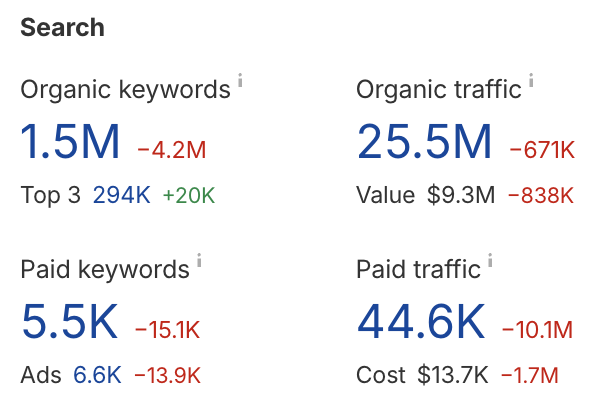
Navigate to “Site Explorer” and enter your URL. Click through to the organic keywords report in the left-hand menu or by clicking the hyperlinked keyword amount.
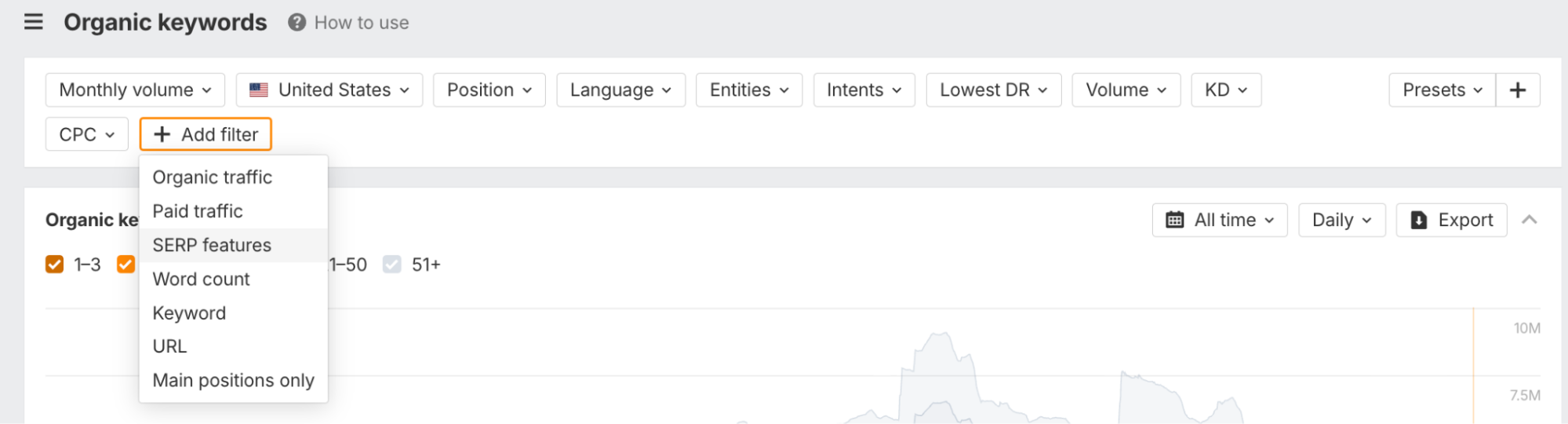
Click “Add filter” and select “SERP features”.
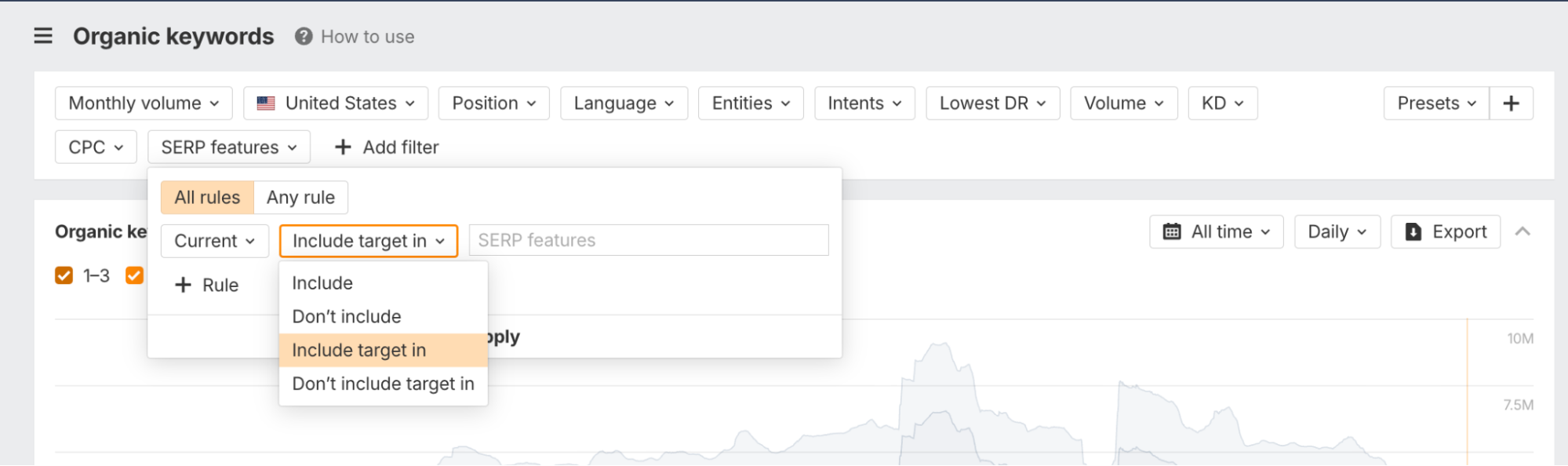
Select “Include target in” from the second dropdown menu. Applying this filter will surface the keywords where one of your pages is included in a SERP feature.
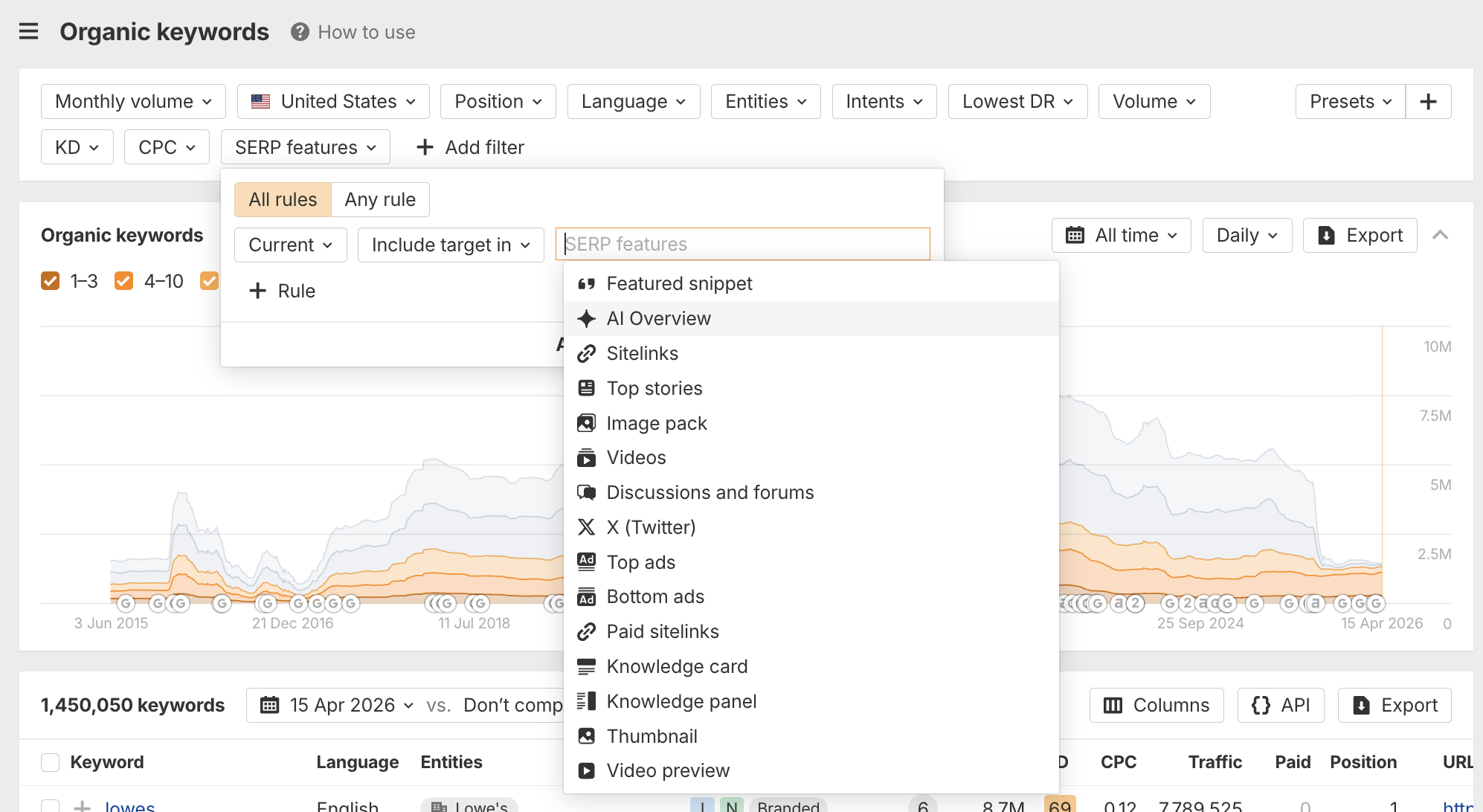
Choose “AI Overview” from the dropdown menu and then click “Apply.”
Click “Show results” to see which AIO citations your pages are included in.
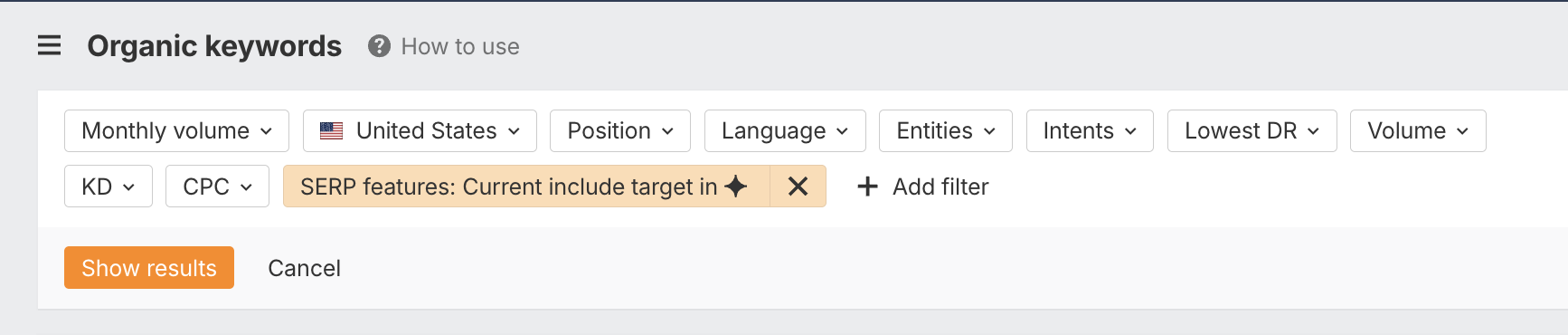
To make navigating to this report easier, turn it into a preset. Click “+” next to “Presets”, enter in a descriptive name like “AIO Citations” and click save.

The next time you want to access your AIO citations in the organic keywords reports, you’ll just need to expand the presets and select the right one. This preset isn’t domain specific, so you can also check your competitor’s AIO citations to identify content gaps.
Use Ahrefs To Identify Citation Opportunities
If you have pages ranking for terms where AI overviews appear, you can improve those pages to increase the likelihood of capturing an AIO citation.
Follow the same instructions as above, but instead of changing the middle drop-down to “Current include target in”, select “Don’t include target in.” Save this as a preset to easily access this later.
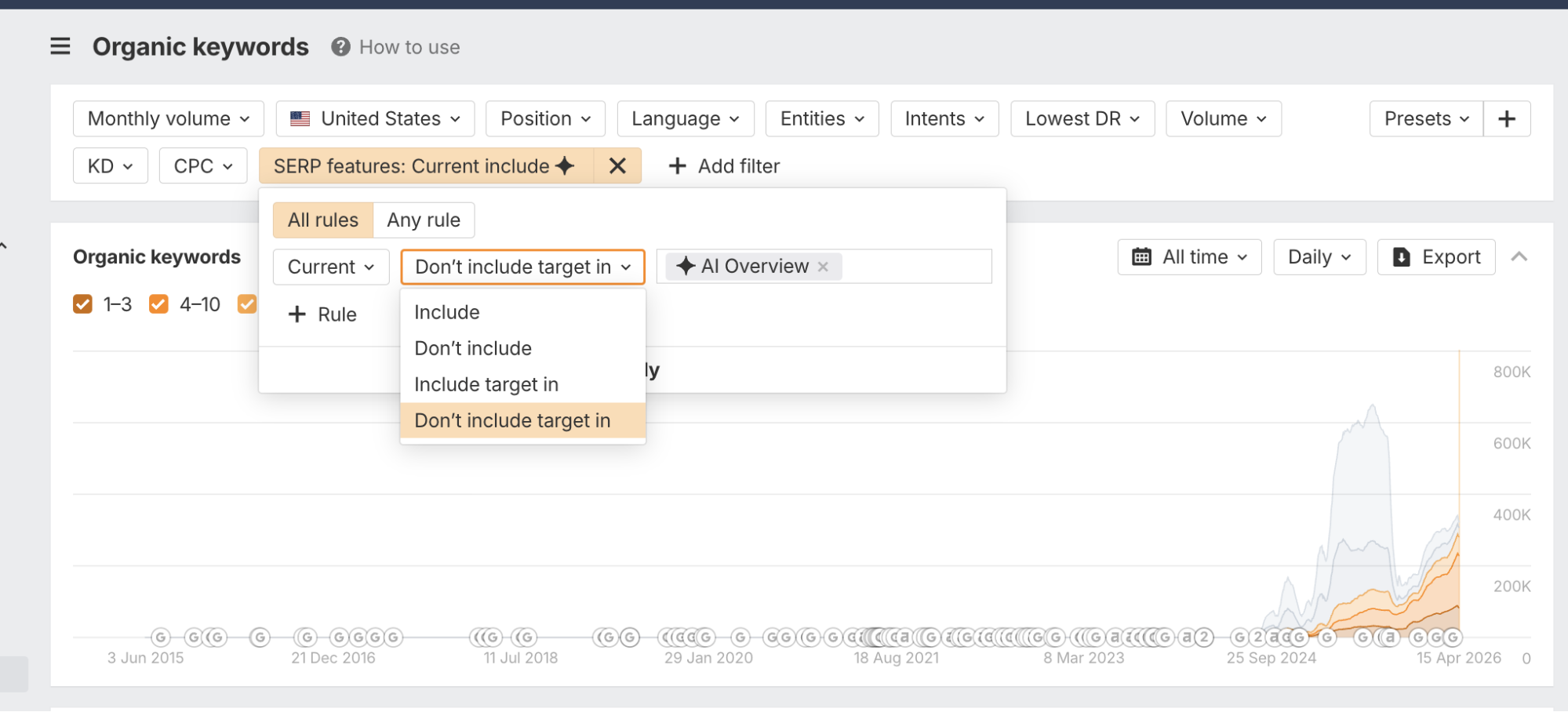
Narrow down the list to pages more likely to get cited by focusing on URLs within “striking distance” of ranking in positions 4–19. These are typically low-hanging fruit opportunities that Google has already identified as valuable but may be missing the depth, optimization, or even visual elements needed to earn stronger visibility.
Find AI Overview Citations in Semrush
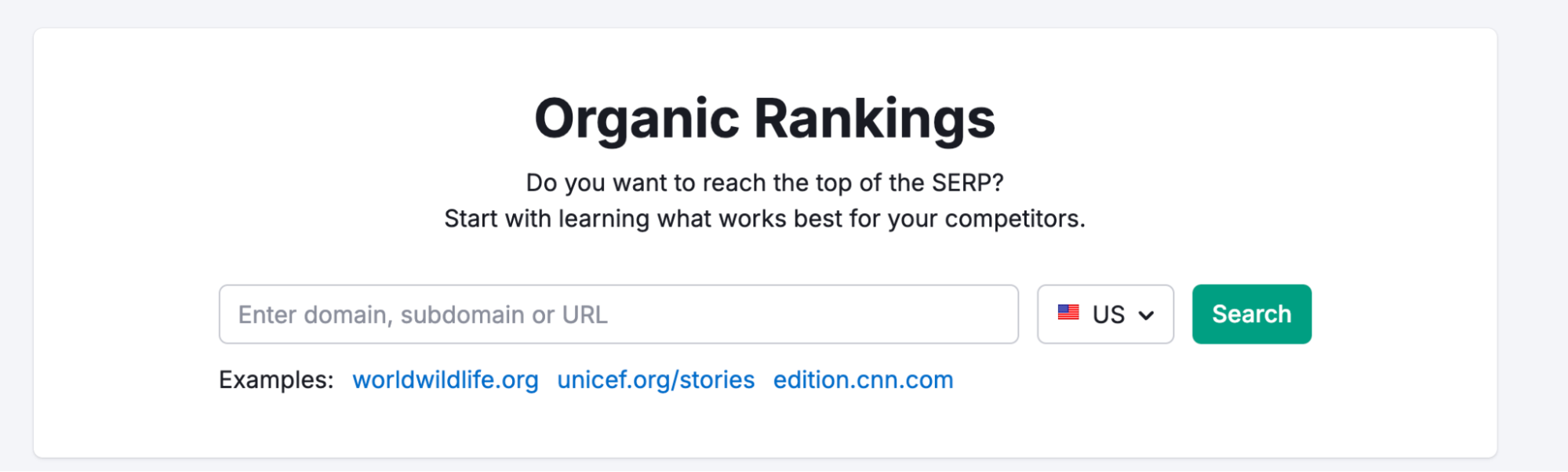
Head over to the Organic Rankings report in Semrush and enter your domain.
Scroll down to the “SERP Features Trend” card and click “View all keywords.”
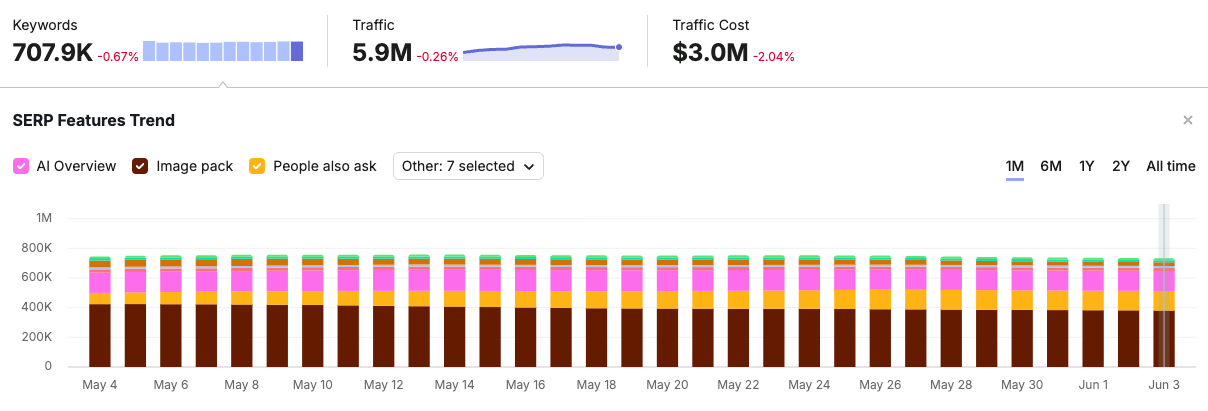
Click on “SERP Features” drop-down, then choose “Domain ranks” and select “AI Overview.”
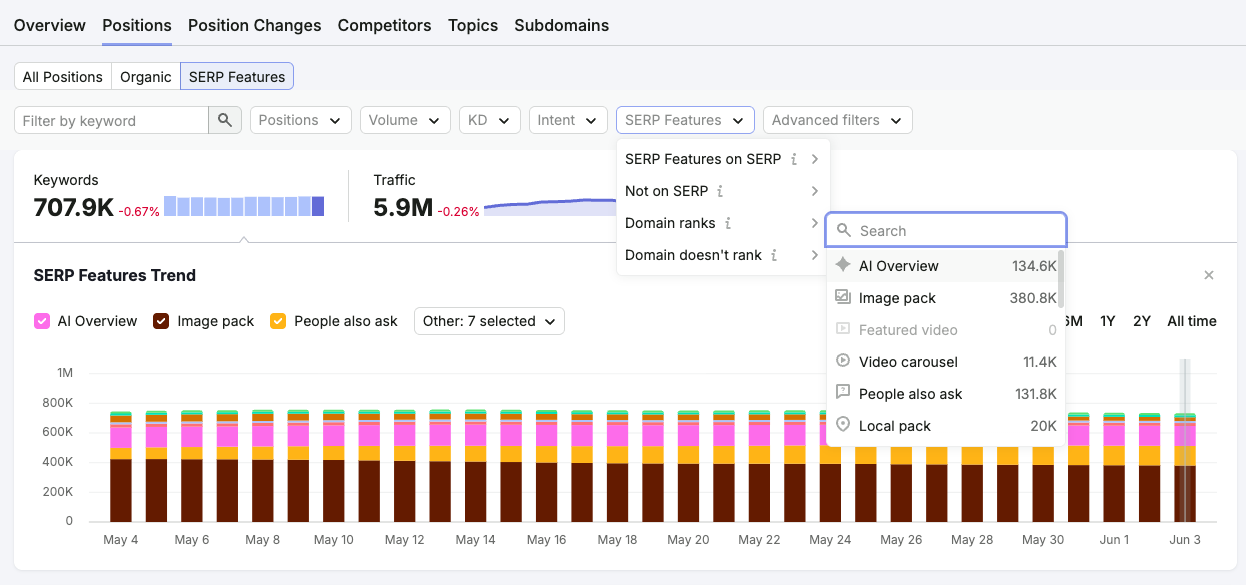
You can now see all the keywords featuring AI Overviews where you’re cited.
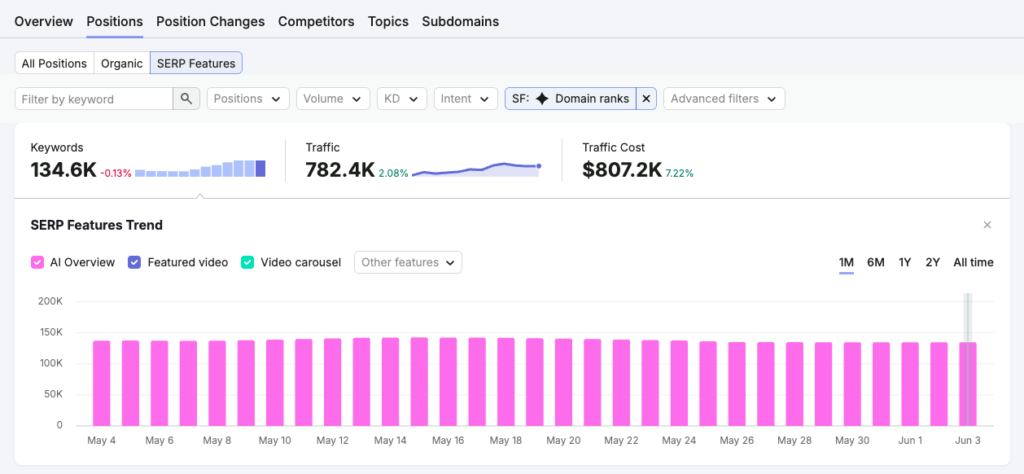
Find AI Overview Optimization Opportunities in Semrush
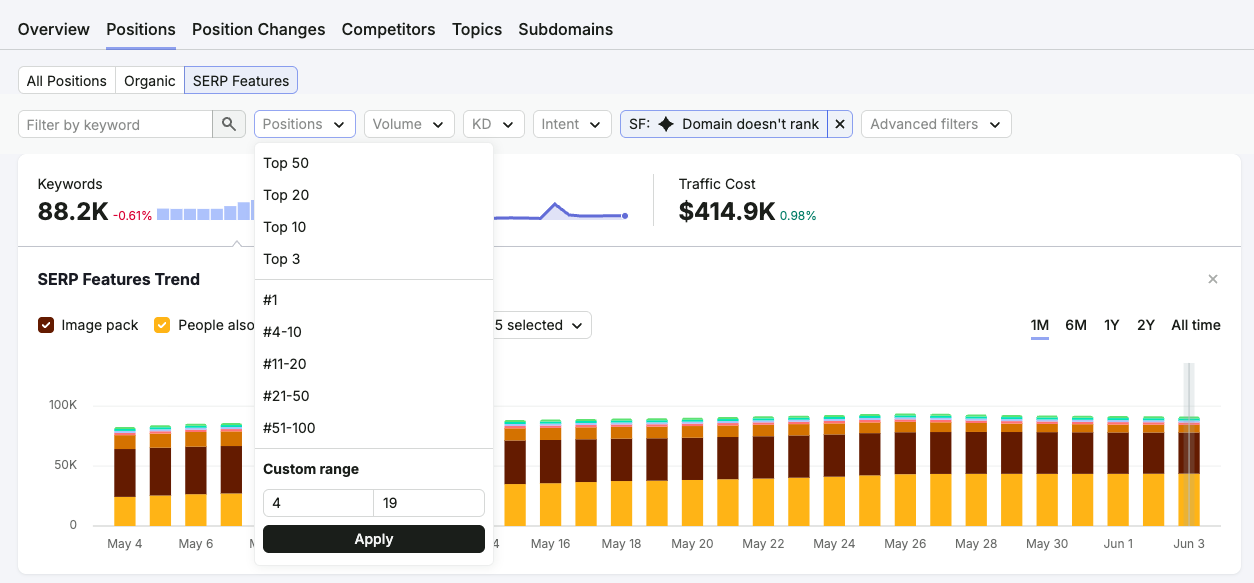
To see which pages you can improve to gain citations, follow the steps above, but click on “Domain doesn’t rank” menu and then select “AI Overview.” Make sure you’re in the “All Positions” tab. For further refinement, use the “Positions” drop-down to whittle down your list to page ranking in positions 4-19.
Best Practices for Optimizing Content for Google AI Overviews
While AI systems use a different approach to surfacing information than traditional search and rely heavily on synthesizing content from multiple sources, traditional SEO best practices still hold strong, according to Google’s own 2026 guide on optimizing websites for generative AI features.
Creating valuable, non-commodity content and demonstrating strong E-E-A-T (Experience, Expertise, Authoritativeness, and Trustworthiness) signals remain critical. If anything, these factors have become even more important in an era where AI-generated content has flooded the web with millions of low-value, repetitive pages. To truly stand out and improve your chances of ranking in AI Overviews, brands need to offer a unique perspective, original insights, and firsthand experience that goes beyond what’s already widely available.
At the same time, newer concepts like retrieval-augmented generation (RAG) and query fan-out are reshaping how content gets surfaced in search. These systems use AI to retrieve, compare, and synthesize information from Google’s Search index, which means your content still needs to be discoverable and technically accessible.
That’s why technical SEO remains essential. If Google can’t crawl, render, index, or understand your content, it’s unlikely to be included in AI-generated results.
1. Make Your Content Easy To Scan & Understand
AI Overviews are designed to deliver quick answers, so content that clearly communicates information has a better chance of being surfaced. Vague generalizations are harder for Google to understand and cite. Therefore, ensure that you communicate your ideas and present information in a clear, concise, and easy-to-read format.
- Start key sections with a concise summary that directly answers the searcher’s question
- Use bulleted and numbered lists to break down processes, recommendations, and key takeaways
- Structure content with descriptive H2s and H3s that mirror the questions users are asking, if possible
- Use tables, comparison charts, and callout boxes where appropriate to improve readability and skimmability
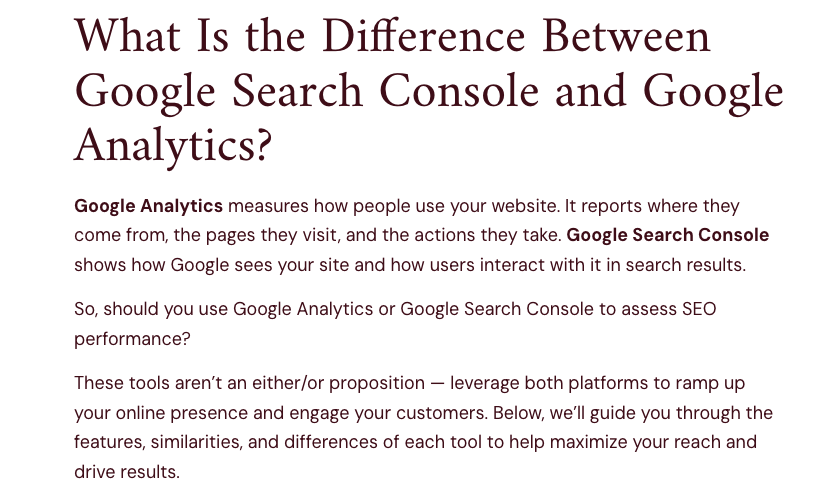
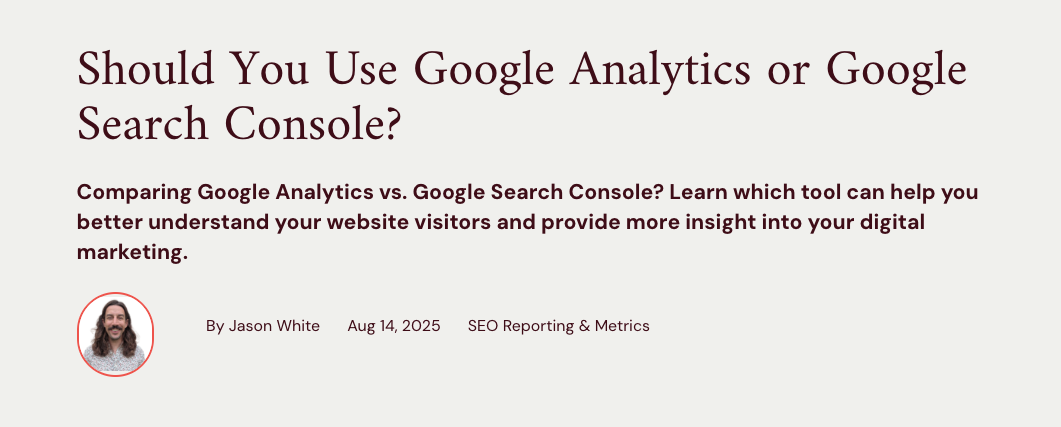
For example, one of our blogs, “Should You Use Google Analytics or Google Search Console?”, is cited in AI Overviews for the query “google analytics vs google search console”. Rather than burying the answer deep within the content, the article immediately explains the differences between the two platforms at the top of the page, making the information easy for both users and search engines to find.
2. Add an FAQ Section or Structure Your Content in a Q&A Format
FAQ-formatted content appears frequently in AI Overview citations. If you haven’t already covered important questions in the content, add an FAQ section to the end. Each question should match how a real user would type the query. Each answer should be self-contained and direct. Even though Google does not recognize FAQ Schema anymore, answering related questions around the topic in a Q&A format improves user experience and entity recognition.
- Address common follow-up questions throughout your content
- Cover the who, what, when, where, why, and how behind a topic to reduce information gaps
- Similar to the recommendation above, make sure your heading structure follows a logical hierarchy, with H1s followed by H2s, H2s followed by H3s, and so on
Returning to our previous example, the article follows an FAQ-style structure, with each header reflecting a common user question about the topic. Each section then provides a concise, direct answer, making the content easy to scan and understand.
3. Demonstrate E-E-A-T (Experience, Expertise, Authoritativeness, and Trustworthiness)
As mentioned above, Google continues to emphasize Experience, Expertise, Authoritativeness, and Trustworthiness when evaluating content quality and deciding what sources to cite in AI Overviews. The following best practices can help your pages not only demonstrate strong E-E-A-T signals but also stand out in an increasingly crowded landscape of low-quality content.
- Include unique insights and PoV from subject matter experts
- Share firsthand experiences, examples, case studies, or lessons learned
- Cite reputable industry sources and support claims with credible evidence
- List author credentials, showcase leadership expertise, and highlight relevant industry experience
For example, at Victorious, each piece of content (including this one!) is reviewed by team members with specialized expertise in technical SEO, content strategy, and web development. Every article is also reviewed by a subject matter expert, with author and reviewer credentials clearly displayed and linked on the page.
4. Build Topical Authority & Entity Recognition
Rather than relying on a single piece of content, create a comprehensive content ecosystem around important topics. Also known as content pillars, hub & spoke, or topic clusters, the idea is not new to SEO or AEO, but similar to the importance of E-E-A-T, it plays an important role in communicating to search engines and LLMs that your brand is a true niche expert in a given space.
- Develop entity pages supported by related articles that cover subtopics in greater depth
- Link related content together to reinforce topical relevance
- Continuously update key resources as information evolves
- Do not forget about strategically placing internal links to the relevant content
For example, to build the topical authority around analytics tools, Victorious has created a variety of blogs to address common questions about Google Analytics and Google Search Console, such as “How To Use Google Search Console”, “How To Connect Search Console to Analytics”, “How To Measure Website Traffic With Google Analytics 4”, and more.
5. Incorporate Original Insights, Research, and Media
One of the best ways to stand out is by publishing information that doesn’t exist elsewhere. If you have unique information or research to back up your content, do not hesitate to use it to improve your content’s retrievability chances.
- Include original research, survey findings, or proprietary data
- Create custom graphics, charts, videos, and visual assets
- Add expert commentary, interviews, and unique insights
While not every article needs to feature original research or proprietary data, publishing this type of content can help establish your authority and support the broader content ecosystem on your site. For example, Victorious recently published the Quarterly Search Report, where we analyzed how brands perform in AI search versus traditional search across five industries. Our findings challenged the common assumption that the same factors drive visibility in both search experiences.
6. Strengthen Technical SEO Foundations
Even the most authoritative high-quality content can’t be surfaced in AI Overviews if search engines or LLMs struggle to access or understand it. AI-powered search experiences still rely on content that can be efficiently crawled, indexed, and retrieved. Because of this, the technical site health is an important consideration for your AI search strategy.
- Ensure important pages are crawlable and indexable
- Improve site speed and Core Web Vitals to enhance user experience
- Use a logical site architecture and internal linking structure to help search engines understand relationships between topics
- Implement relevant structured data where appropriate to provide additional context about your content
For example, our Should You Use Google Analytics or Google Search Console? article follows technical SEO best practices, such as a clear header structure, proper indexation, and a strong internal linking framework that help search engines access and understand the content.
What NOT To Do When Optimizing for Google AI Overviews
Now that we have covered some of the best practices for AIO optimization, let’s briefly discuss what tactics might hurt your website rather than help you improve your organic visibility.
1. Don’t Chase AI Optimization Hacks
There’s currently no shortcut, special schema, or magic code to earning AI Overview citations. Rather than looking for loopholes or quick wins, focus on creating genuinely helpful, authoritative content that answers users’ questions better than competing resources.
2. Don’t Create Special AI Files or LLMS.txt Files
According to Google, you don’t need LLMS.txt files, AI-specific sitemaps, special markdown files, or custom markup to appear in AI-generated search results. Search engines can already crawl and understand a wide variety of content formats, and there is currently no special file type or schema that guarantees AI Overview visibility.
3. Don’t Break Content Into Artificial “Chunks”
While having clear and concise paragraphs and answers to the audience’s questions is important, do not overdo it by breaking down content into unnatural chunks. Google’s systems can understand both short and long-form content and identify the most relevant sections to surface. Instead of optimizing for arbitrary chunk sizes, focus on creating content that serves your audience and is organized logically.
4. Don’t Rewrite Content Solely for AI Systems
You don’t need to force exact-match keywords, stuff pages with long-tail variations, or write in a robotic style to be understood by AI. Modern search systems can recognize synonyms, context, and intent. Prioritize clarity and usefulness over keyword manipulation.
5. Don’t Abandon Traditional SEO
Perhaps the biggest mistake is assuming that AI search has replaced traditional SEO. Google’s own guidance makes it clear that the fundamentals still matter. Strong technical SEO, high-quality content, E-E-A-T, topical authority, and a positive user experience remain the foundation for visibility in both traditional search results and AI-powered experiences.
Update Content Briefs and Outline Process To Include AIO Optimization
If you haven’t already, you’ll want to add retrievability requirements to your content briefs and outline process so your writers follow current best practices. Building these in improves citation likelihood for content you publish going forward.
Your briefs and outline should include:
- Which terms trigger an AIO
- What the AIO currently states and who’s being citied
- Which terms trigger a People also ask box
- The questions associated with the search terms
- Information about structure and leading with answers
Build AI Overview Monitoring Into Your Content Review Cycle
AI Overview coverage continues to expand, and the sources Google selects can shift. Build a regular review into your SEO content process where you re-check your highest-impression informational queries for AI Overview presence and evaluate whether your pages are in the citation set.
Use Google Search Console to monitor impression and click-through rate trends on pages you’ve updated. A stable or growing impression count paired with a declining click-through rate can indicate that an AI Overview is now appearing for a query and capturing user attention before a click happens. That’s a signal to verify whether your content is in the citation set and, if not, whether additional structural updates would help.
When your content is genuinely more useful and more extractable, it earns better performance across both traditional organic results and AI-generated answers. Citation mechanics follow from getting that right.
What Victorious Does for AI Search Visibility
AEO is a core part of what Victorious builds into every client engagement. We track AI Overview presence across client query sets, identify which pages are citation candidates, and structure content to meet the extractability requirements AI systems favor while staying focused on quality, relevancy, and usefulness. That work runs in parallel with traditional SEO so visibility compounds across both channels.
If you want to know which of your existing pages are positioned for AI Overview citation, and what changes would increase your chances of appearing there, schedule a free consultation.