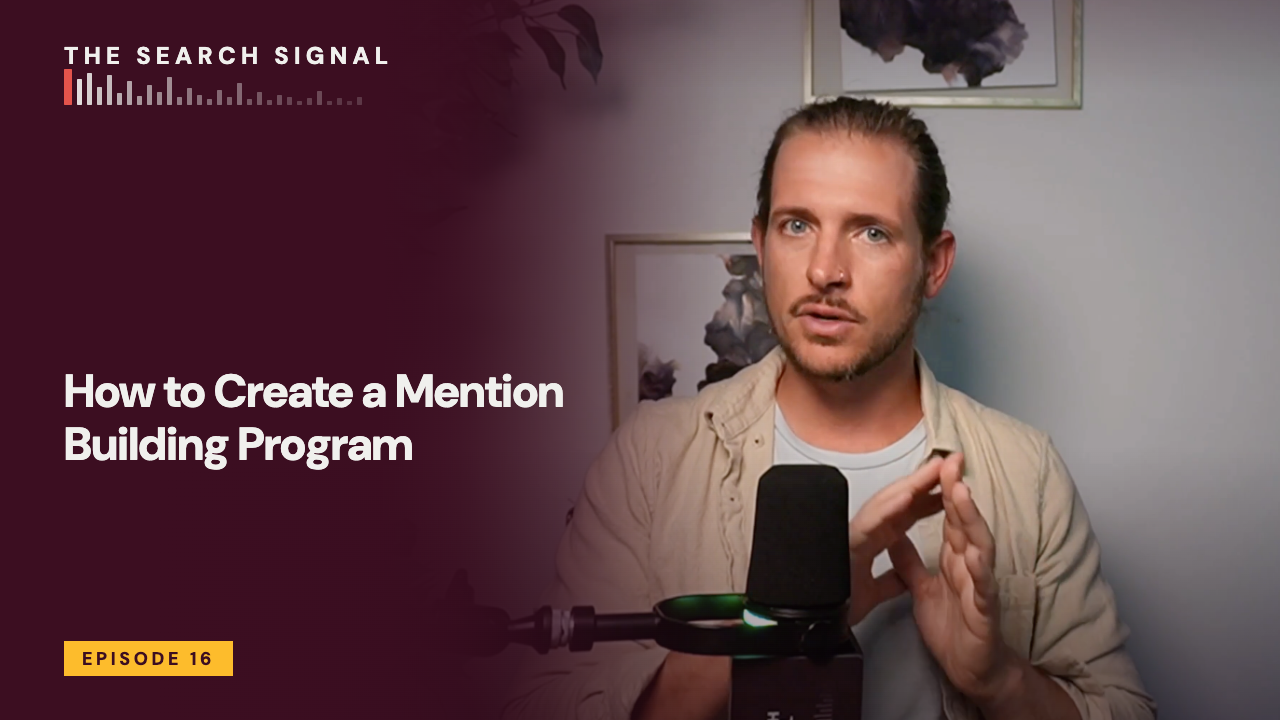
Episode 19 · The Search Signal
About this episode
A click report can't show you the moment an AI assistant decides which companies to recommend. That conversation happens before any visit. It's private, and it never lands in your analytics the way an ad click or an organic session does. So the question many marketing teams can't answer from their own dashboards is simple. When an AI platform names a handful of companies worth considering, what put those specific companies on the list?
In this episode, Michael Transon makes the case that the companies on that list usually showed up earlier, in the sources AI cited while the buyer was still researching the problem. Watch to learn what the Q3 data shows about research-stage citations, why AI is leaning on fewer sources, and whether mentions or links do more to get a brand named. Track those three now and you'll have a baseline before next quarter's report lands.
Michael's POV in 60 seconds
One thing
Marketing teams can see their research content losing clicks since AI Overviews launched, and in response, some have cut back on producing it. The thinking is that content sending fewer clicks is doing less for the business.
So what
Victorious's Q3 report found that brands AI cited on research-stage questions were named when buyers asked who to choose 94% of the time, against 50% for brands with no early citation. Tracked from July to October, 81% of brands that picked up research-stage citations went on to get named at the buying stage, against 21% of brands that didn't. Judging that content by its clicks misses that it's clearing a qualifying round before anyone starts comparing providers.
Now what
Redeploy some budget into research content now rather than wait for a second quarter of data, and tie that content to the commercial pages it's meant to support. Alongside it, track whether that content gets cited at the research stage as well as whether the brand gets named at the buying stage. Read both as a monthly trend, since a single week's number moves too much to judge on its own.
Questions this episode answers
How do I find the research-stage questions that matter for getting cited?
Look at the questions your sales reps hear from prospects and the ones your support team gets from customers, along with what shows up in forums and in Google's People Also Ask box. Those tend to be the questions buyers ask right before they start comparing providers, which is the stage where AI's citations now carry the most weight.
How do I know if my brand's AI visibility is improving?
Many SEO tools can already count how many other sites mention your brand, so set a baseline this month and check it every quarter. Mentions and links each predict being named on their own, and links carry slightly more weight. Only about 6% of the pages that mention a brand also link to it, so track both instead of assuming one covers the other.
Should I deprioritize rankings now that AI search is in the mix?
No. For Google's AI Overviews, organic rankings are still the single biggest input behind what gets cited, more than for any other platform tracked in the report. Keep your ranking work and your AI search work on the same plan, and build off-site mentions and links for the platforms where rankings carry less weight.
Chapters
This Week in Search: Google Rankings Swing Without a Confirmed Update
This Week in Search: Two Critical PHP Security Flaws Patched
This Week in Search: Do AI Platforms Really Send No Traffic?
Victorious Publishes Its Q3 2026 AI Search Report
How Victorious Built This Quarter's Study
The Headline Finding: Early Citations Predict Being Named
Where AI's Research-Stage Citations Are Shifting
Which Brands Got Squeezed Out This Quarter
What Actually Predicts Being Named by AI
Why AI Is Citing Fewer Sources Overall
How Each AI Platform's Source Mix Is Changing
Google's AI Overviews Still Runs on Rankings
Turning the Findings Into a Plan
What We're Watching for Next Quarter's Report
Big Takeaways From the Q3 Search Report
Resources mentioned
Take this further
Don't miss an episode
New episodes every week. Get them in your podcast app of choice, or watch on YouTube.
Full transcript
Michael 00:00 – 00:39
So the brands AI cited when buyers were still learning about their industry or their category, those brands were almost twice as likely to be named when buyers actually asked who to choose. And if you think about this is also how buyers, human buyers behave too, The company that, for most people, explains the problem or gives information, usually has a head start when it's time for that buyer to actually choose who to work with. Hey, welcome back to The Search Signal.
Michael 00:39 – 01:21
I am Michael Transon. I'm the founder and CEO of a search marketing agency called Victorious. And here at The Search Signal, our goal is really simple. I'm here to help marketers understand and also take action on what is happening today in the big world, quickly moving world of search marketing. So at Victorious, we have been running campaigns for gosh, nearly 13, 14 years. We work with some of the fastest and biggest growing brands out there in the market. And what we do is we bring what we learn from those experiences, plus what we're going to talk about today, a lot of our own first-party data and research to The Search Signal to help you with your own work. So we just published, very excited, our Q3 quarterly search report at Victorious.
Michael 01:21 – 01:51
So after the news today in this episode, I'm going to spend the rest of the episode on what we found and also what has changed since the last quarter. So before we get into that, let's talk about what happened this week in the world of search marketing news. Okay, let's start with Google rankings. So, over the past week or so, if you have not seen ranking tools, ranking track tools, and a lot of actual website owners are reporting huge swings.
Michael 01:51 – 02:27
This first started on October 20th and 21st, and then also came up again on October 24th. Now, Google has not confirmed an update and it has not released a core update to its algorithm at all in the third quarter so far. So if you have not seen some of what the trackers are showing may also be related to their own data problems. there was a rank tracker, a couple of them that have research published in the last week that found that Google has actually been feeding rank tracking tools with altered or poisoned SERP results and pages since September.
Michael 02:27 – 03:14
We talked about that last week in the episode. So what I would say is before you react to any sort of swing that is happening, please check Search Console. That is Google's own data. And it's on real searches. But I would say I'll probably would expect a little bit more rank movement to happen going forward. And that's because as Google systems are getting better and better and as they're putting more computing power behind them, rankings are going to move a lot more often, in my opinion. And oftentimes that may be without an announcement. Next, a very quick one, actually not related to SEO at all, but there were two serious security flaws that turned up last week in PHP, which is the programming language behind a lot of websites on the internet, particularly WordPress websites.
Michael 03:14 – 03:45
The vulnerability lets an attacker run code on a server without having to log in. So, good news is patched versions are out for this right now. So whomever manages your website, if they haven't done it automatically, please patch it and you should be good to go. Okay, the last story this week, this probably got the most attention, to be honest. There were three studies that came out this week that said AI search sends almost no traffic to your website compared to Google.
Michael 03:45 – 04:23
The biggest study looked at about 100 websites and 145 million sessions over an entire year. And it found that ChatGPT sends about six-tenths of a percent of as many visits as Google organic search. Now, those ChatGPT visitors, though, converted at about four and a half times the rate of Google's, but Google still drove 96 or 90% of the total conversions. And then there was a second study in that list that found that organic search sent 39 times more traffic than AI assistants.
Michael 04:23 – 04:56
And then a third study across like 12 sites could not find a lift in branded searches or direct traffic that. It that it could tie to AI visibility. Now, all three of these come from people inside of the SEO industry, which, you know, same kind of source our own research comes from. So I personally hold them to the same standards. I would hold Victorious in ourselves to our research. But what I want to say is I think these studies, they're taking a measurement problem that everybody already knows about, and then they're using it as, in my opinion, proof.
Michael 04:56 – 05:34
That AI search just doesn't matter. But we know this already. Most of what AI search does to a buyer is not going to show up as a click. Someone is asking ChatGPT which companies to consider, and they might hopefully see your name. And then a week later or a day later, they search for you on Google or they type your name into a URL. Now that visit might get credited to paid if they clicked on a link or to direct traffic. But the AI conversation that started the whole thing never showed up because AI conversations, like we talked about before, are frustratingly private and your analytics are not able to follow them right now.
Michael 05:34 – 06:20
AI visibility at the end of the day is not about traffic, it's about influence. I've said this before, it is the new word of mouth, and nobody has ever measured word of mouth by how much traffic they're getting or referral traffic from their website. Now the strongest point against me, to be fair. Balanced here is the third study, which went looking for exactly that type of lift in branded search and direct traffic, and they couldn't find it. And that's a very valid fair point. And it's also why I would measure influence directly by tracking how often AI names your company when buyers are asking about your category alongside of the traffic. And as luck would have it, our new research that we're going talk about today looks at what AI does.
Michael 06:20 – 06:55
At the moment that a buyer is choosing a solution, which honestly no click data is ever going to show you. So that is what today's entire episode is about. I'm super excited. Let's dive in. So, if you're not aware, every quarter at Victorious, we publish our own independent research on how AI search treats a fixed group of brands that we track. And this quarter, we went back to the same 161 brands and we asked AI the same exact questions that we had asked it about those companies three months earlier.
Michael 06:55 – 07:29
And three months earlier in that last quarter, we had found that AI could describe 96% of these brands very accurately when we had asked about them by name. Yet 89% of them never came up when buyers were asking about their category. The brands that AI did name in that list were ones that were mentioned the most across other websites. And almost every source that the AI had cited in our research was from a third-party website and not the brand's own website.
Michael 07:29 – 08:12
So this quarter, the short version of what we found, which is very important, is that AI has gotten a lot more selective. In this run, it named fewer brands this quarter. And it also leaned on a much shorter list of the sources it was using to decide. But the brands that kept their place in this last report had something in common. And it was this: AI was already citing their content when buyers were still researching and learning about their category before anybody had actually asked who they should hire.
Michael 08:12 – 08:42
And that is our headline finding from this quarter's report. So I'm gonna walk you through how we built this report. Then we're gonna spend some time digging into that headline finding. After we do that, we'll talk about who got squeezed out. We'll also talk about where AI is getting more of its sources now versus last quarter. And then also I want to talk about what Google does differently from the other platforms that we're looking at. And then we'll wrap up by talking about how much of this you should treat as noise, what's going to change, what might be permanent.
Michael 08:42 – 09:22
So let's start with how we built this research study because it is honestly very quick for me to walk you through it, but it's also gonna tell you how much you can trust the numbers that we're about to walk through today. So we studied 161 brands and we did this across five different industries. We did e-commerce, financial services, healthcare, legal, and SaaS. And none of these, just for the record, are current or former Victorious clients. We collected about 16,000, 17,000 AI answers across nine different AI platforms, and we did this on September 29th.
Michael 09:22 – 10:02
And we use the same prompts as we did, like I said earlier, last quarter. And then we also looked at about 1.7 million pages on other websites that are mentioning the brands in the group. Now, three of the nine platforms, Claude, Meta, and Grok, they answered these queries without searching the web in our collection. So everything about sources that we're gonna talk about today and citations for answers. Are going to come from the other six that we looked at, which was ChatGPT, Perplexity, Copilot, and then the three Google surfaces, Gemini, AI Overviews, and AI Mode.
Michael 10:02 – 10:36
And I said this earlier, but we keep our clients out of this group very much on purpose because we do not want the results to be shaped by the work that we are currently doing or have done for our clients. And for the headline finding, the most important thing we'll talk about today, we used Ahrefs Brand Radar. And that records how AI platforms answer real questions that US-based searchers are going to ask. And we sorted those questions into two different kinds. There are first research questions, and these are about how something works or what to look for.
Michael 10:36 – 11:10
This would be like what should I check for before I decide to work with an insurance provider? And then the second one is consideration questions, and these are about literally. Who I should choose to work with, using the same insurance question, what are the best insurance companies for small businesses? And everything in this report is a correlation within our specific group of brands. We are showing where things move together. We are not claiming that one explicitly causes the other.
Michael 11:10 – 12:04
So that's how we did this. Let's talk about this very important headline finding. So, like said earlier, our big headline finding for this quarter's search report is AI is recommending and naming and mentioning brands it is already citing. So brands whose content AI cited on research questions were named on consideration questions 94% of the time. This is a huge number. The brands that AI didn't cite on research questions were named only 50 percent of the time. So the brands AI cited when buyers were still learning about their industry or their category, those brands were almost twice as likely to be named when buyers actually asked who to choose. Now, quick caveat, as we're getting to these numbers, one obvious objection we might have is related to the size of the brand.
Michael 12:04 – 12:40
Bigger brands get cited more and they get named more. So maybe that's, you know, you might say, that's all this is. No, we tested it. And after we accounted for how often AI mentions each brand overall, size explained a really small part of the gap, but the relationship was still very, very strong. And then on top of that, we also saw this same pattern, this finding over time. So, prior search report, we ran that on July 1st. There were 40 brands in our group that AI did not name into any consideration question.
Michael 12:40 – 13:14
So what we did is we split them into the brands whose content AI was already citing on research questions, and then the brands that it wasn't citing. So from July to October, 81% of the first group, the ones that were being cited, were now being named in the consideration question of whom to work with. In the second group that was not being cited, In these research-based questions, only 21% showed up in the consideration of who to actually work with.
Michael 13:14 – 13:46
So we read this as a very clear correlation. Being cited at the research stage and being named at the buying stage, those two look like they draw on the same underlying trust in a brand. And if you think about this is also how buyers, human buyers behave too, The company that, for most people, explains the problem or gives information, usually has a head start when it's time for that buyer to actually choose who to work with. And this matters a lot.
Michael 13:46 – 14:20
And it matters because of what happened to informational content on websites over the last couple of years, right? After AI Overviews had launched in Google, that content lost a ton of its traffic and some teams seriously cut back on producing it. My point though is judging that content by the clicks it sends is missing what it does now. Research content has been treated like a traffic play forever. But in AI search, it is looking way more like a qualifying round.
Michael 14:20 – 14:52
So point being the informational content that is tied to your commercial pages, The questions that buyers are asking right before they are starting to compare providers, is very meaningful, very impactful to AI search, and something we have to keep on doing, even if it's not generating the traffic that it has done historically. Now, there's also a bit of a catch too, and we'll talk about this. So the sources that AI cites on research questions are also shifting a little bit.
Michael 14:52 – 15:32
Brand websites, the actual company websites. They went from about 65% of citations for early research to about 56% quarter over quarter in our research. And then you have government websites, which is another category of citations. Those went from only about 4% last quarter to almost 12% this quarter. And then industry association websites, those also went from 4% to almost 10%. So as a result of that, the brand share of citations, actual company's share of citations, they fell on 18 of the 20 research questions that we were tracking.
Michael 15:32 – 16:06
So last quarter, now that we have that established, last quarter, we had asked whether that research stage would stay open to brands that were late to investing into AI search. Now it has stayed open, but, based off of our citation research, brands are now having to compete with institutions for those citations. So, what that means is your research content has to beat the government or the industry association page on the same topic.
Michael 16:06 – 16:41
We've talked about this so much in this podcast, but that means our content has to be more specific. It has to be better sourced, and it has to be kept very current. And on top of that, you know, I would also say those institutions, those industry publications, those are also an opportunity for us. Getting listed in the membership and having your brand be an expert contributing to those pages or those websites puts your brand inside of a source AI already trusts at the research stage.
Michael 16:41 – 17:13
Now, finding the right research questions on top of this doesn't always take a tool. You can look at what prospects are asking, like your sales reps. You can also ask what customers are asking your support teams or what they're asking in forums. Also the questions that Google shows and its People Also Ask box. Those are really great questions. And those come right before someone starts to compare providers. And those are the ones that really matter here when we're talking about which questions to consider answering and getting citations for your brand.
Michael 17:13 – 17:45
So if we want to compete against government sites and we want to compete against industry sites to get citations, a page that gets cited on those questions does tend to look a specific way, It has to answer the question directly at the top. It has to show its sources. It also has to have something that an institution page doesn't have, like your own unique internal data or a real example from the work that you do. I also strongly recommend naming experts and giving them POV and content.
Michael 17:45 – 18:22
And we have to keep it up to date. Like I said, it has to stay current because, institutional pages usually don't change for a long time. And we have the ability to take advantage of that. But this also changes what to measure. So for every buying question, every consideration question that you are tracking inside of AI, we have to be able to add two, three, four, five research questions that buyers are asking before they get there. And we have to track whether our content is getting cited in those answers and not only whether or not our brand just gets named in the buying ones.
Michael 18:22 – 18:52
So that's the brands AI picked. Now let's talk a little bit about the brands in our study that actually dropped and why. So another big finding from this quarter's search report is that AI has been naming fewer brands in its answers, and the bar to get named is also going up. So last quarter in our research, AI named 42 of the brands in our group. This quarter, 15 of those 42 dropped out. Two were newly named. So there are now 29 total brands.
Michael 18:52 – 19:28
That is a net loss. And a net loss that size. In my opinion, is very unlikely to be just by chance. So most of the losses from what we can see came from brands kind of in the middle. And specifically as it relates to third-party mentions. The brands that had somewhere between 2,000 and 10,000 mentions on other websites were the ones that saw losses. Now, the brands that were named the most often, which is our biggest finding from last quarter's search report, those stayed the same in both quarters.
Michael 19:28 – 20:03
But the bar to get named, like I said, also has gone up based off of what we are seeing in the research. So last quarter, a brand had about a 50 50 chance of being named once it had reached about 20,000 mentions on other websites. This quarter, that point moved from roughly 24,000 to 28,000. And being named once is also a Really, really low bar. To have a 50-50 chance of being named in at least one search in three of the six platforms that searched the web.
Michael 20:03 – 20:42
A brand needed about 44,000 mentions. And this is why this really does matter for you and for me and for brands. 11 of the 29 named brands in our research showed up on only one platform. Seven of them. Only seven showed up on all six. So my point being is one mention and one AI answer is not visibility. Showing up across a lot of platforms, that's visibility. And that takes a very big footprint across the web that every system is able to use to find you.
Michael 20:42 – 21:18
And now, so we also tested in the search report this quarter which kinds of web presence matter because this is where something has actually moved from last quarter to this quarter. So last quarter, we found that links from high authority websites gave brands a small extra lift beyond the raw number of links that they had. this quarter, and I was very surprised to see this. That lift mostly went away. And then also whether the links were follow links or no follow links.
Michael 21:18 – 21:50
Based off of our research, made no difference once we had actually counted brand mentions. And neither did branded search volume or like reviews on your GBP. But what did predict being named was the number of websites that mention a brand and the number of websites that link to the brand. Each one of them counted on its own, but between being mentioned and being linked. But the same as last quarter to this quarter, links carry just a little bit more juice.
Michael 21:50 – 22:20
And on top of that, only about 6% of the pages that mention a brand also link to it. So those are mostly two different sets of websites that are linking to you and mentioning you. So what's the move or what's the action that we take based off of this? One word. Breadth. We need to count the publications. We need to count the lists and the communities. The ones that are naming our company, and we have to grow that number.
Michael 22:20 – 22:51
Most SEO tools, if you pay for SEO tools, they can count the pages on other websites that mention your brand. So we have to get a baseline and we gotta get it this month, and we have to watch it every quarter, In practice, though, breadth means going to trade publications, industry directories, any comparison lists. We've talked about this before, podcasts, event pages, threads, UGC content. Each one of them ideally being built and naming your brand right next to the thing that you actually do.
Michael 22:51 – 23:29
So like we've talked about when it comes to the moves between these two search reports, the middle of the market right now is where, from what we're seeing, AI visibility is the most fragile. So a brand, if this is you, a brand has a couple thousand mentions, you can show up, like for example, last quarter in our report, but then this quarter disappear and you have not changed anything on your own website. Which in my opinion raises a very important next question, which is if AI is naming fewer brands, where is it getting its information from?
Michael 23:29 – 24:12
Well, what we found from that in this quarterly search report is that AI is actually citing fewer sources than it used to. So in every industry that we had tracked in this report, the 10 websites AI cites most took a much bigger share of the total citations this quarter. So for the top 10 websites in the legal portion of our report, in that industry of our report, they went from about 41% of citations to about 51% of total citations. The top 10 websites in healthcare took 33% of citations the last quarter and they're at 41% this quarter. For e-commerce, the top 10 websites that were being cited had 21% citation coverage last quarter and they went up to 30% this quarter.
Michael 24:12 – 24:53
The financial services and the SaaS industries moved less, but they did also move in that same direction. And let's call one out specifically. In legal, there are three directories that now account for about a third of all of the citations on category-based questions. And the three most concentrated industries, which in our report were legal, healthcare, and financial services, those are the three that Google treats as high-stakes topics. And these are the ones where, you know, a bad answer in those pages or those sites can hurt someone's health, they can hurt their money or their legal situation.
Michael 24:53 – 25:27
And that fits with AI leaning on established sources where the stakes are going to be the highest. So that's very important for us. But also on top of that, let's talk about platforms, the actual LLM platforms. ChatGPT, quarter over quarter, has changed the most out of any of them. So particularly last quarter in our research, ChatGPT cited Reddit in 220 out of the 1,000 answers that we got back.
Michael 25:27 – 26:12
This quarter, it cited Reddit in exactly zero of the 1,000 answers in any of the industries that we were tracking. Wikipedia also dropped, which was shocking to me. And ChatGPT itself was moving its citations towards industry publications and also association sites. Now the other platforms barely changed on Reddit. And I think it's important that I do say Google's AI Overviews kept Reddit and YouTube as their top two sources in both studies last quarter and in this quarter. So if you've been putting any time at all into like Reddit, I would strongly recommend measuring it and measuring it by platform.
Michael 26:12 – 26:46
AI Overviews versus Claude versus ChatGPT before you decide to totally pull back on it. It still does matter a lot for, like I said, Google AI Overviews. And also, it's really important to say it does still count towards the overall web footprint. And we know that that predicts being named over all of the LLMs and all the search surfaces. But what has changed is that for now, Reddit, for example, is not a direct path into ChatGPT's citations. So ChatGPT changed a lot. Also, Gemini changed a lot overall.
Michael 26:46 – 27:34
Based off of our research, only seven of its top 20 sources from the last quarter for citations were still in the top 20 this quarter. And also very interesting, Copilot actually moved away from LinkedIn, which went from about 1% of all of its citations to this quarter, which was pretty much nothing. The platforms also, which was surprising, disagree with each other a lot more than you might and I might actually think you can ask two of the platforms, and we did this. We asked two different platforms the same question, and they only share between four and 10% of the websites that they're using for citations. So, you find the 10 sites that get the most AI citations in your category and on the platform that your buyers use.
Michael 27:34 – 28:19
And I would treat that as your priority list for getting more coverage and getting it included in the listings, but it'll be a different list. For every industry and more and more for every platform. And we talked about this before, but building it is also very, very straightforward. We can run the questions that your buyers are asking on each of the platforms that they use. You can use a tool or you can write down what they cited in the answers, document that, get it into your marketing system. And then we can see how those move and change over time. And I've said this before, but we recommend doing this every month because citations are constantly moving. Now, before we move on, I also want to say there's one platform that is behaving much differently from the other platforms that we were tracking in our search report. And that is going to be Google.
Michael 28:19 – 29:00
So, our fourth finding from this quarterly search report is that Google's AI seems to still be running on ranking signals. So, AI Overviews, they have been growing exponentially. In this report this quarter, AI Overviews showed up on 97.5% of the searches that we ran on Google. This is up from about 73% last quarter. We have brought this up multiple times in prior episodes about how this is going up pretty significantly. And then on top of that, 37% of the sources that AI Overviews cited were pages that were ranking in Google's top 10 for that same question.
Michael 29:00 – 29:46
Now, for context, for ChatGPT and you know, Copilot and Perplexity, that number, the overlap between showing up in the top 10 and being used as a citation, when I said that AI Overviews had about 37%. Those three, the number was between I think 13 and 18%, so much lower. Point being, for Google's AI, your organic rankings are the single biggest input. They are the single correlating factor. So I would say it's very important from an SEO perspective, we have to keep our ranking strategy and our SEO work in the same plan as our AI search work. Now for the other platforms, the lever is the presence on other websites.
Michael 29:46 – 30:26
And we have gone through that at detail, getting more brand mentions. But that also accounts for most of what AI Overviews also cite. And this also, honestly, this tracks back to some of the traffic debate we have been talking about. So when a study like we talked about says AI sends a sliver of Google's total traffic. We have to keep in mind, on the categories and the category questions that we tracked, Google showed an AI Overview almost every single time, 97.5% of the time. So a lot of what your analytics counts as Google traffic now passes through Google's AI first in the form of AI Mode and AI Overviews.
Michael 30:26 – 30:57
And this also explains a question we hear a lot about on a lot of our calls right now. People are asking, our traffic is down, but our rankings are not down. So what's going on? Since late August, Google has been opening up some of those AI Overviews on the top of search results to full length automatically, which is pushing the organic results further down the page. So what that means is steady rankings with fewer clicks is exactly what that change to AI Overview real estate in SERP results produces.
Michael 30:57 – 31:45
Search Console, we've talked about this, now has a report that shows how often your pages are appearing in Google's AI features. So you can actually, for the first time, see it in your own data. I do want to also say one other thing before we move on about Google. AI Mode and AI Overviews share about one in 10 of the websites that they cite for the same question, which you would expect them to use the same, but they don't. So, what keeps you in AI Overview and performing in AI Overviews might not carry over if AI Mode, which I've said before, my thesis becomes the default way that people ultimately search. So with all of those findings from the report this quarter, the question then becomes how do we actually plan around what we are finding?
Michael 31:45 – 32:18
So, a question you might have after all of this is, should I change my plans for search based off of one quarter of data? I think there are two very fair ways that I would look at it. Okay. you can first adjust your emphasis without changing your direction. Since the direction from this quarter search report does match what we talked about and saw last quarter, which is that AI names the brands with the broadest and biggest presence across the web. That has not changed at all from quarter to quarter.
Michael 32:18 – 32:55
Please hear that clearly. So you can change emphasis, keep direction, or you can consider moving some things right now. Because our first finding we talked about is very strong. And it's about research content. And producing research content is going to take months to earn citations. And if you are waiting to deploy or redeploy a top-of-the-funnel content strategy, and you wait till next quarter because you want more data to confirm it's actually what we think it is, you're going to start a quarter behind.
Michael 32:55 – 33:37
So, my recommendation at this point is take some budget towards research content and tie it to your commercial strategy and your commercial pages right now, and keep building breadth across the sites that AI trusts. We have to get more mentions. And I would strongly recommend we redeploy a research content strategy to get more citations. Measuring this is going to take two layers. We start with what AI is doing with your brand right now, which is going to come from tracking your buyer's questions across different AI platforms. How often an AI cites you?
Michael 33:37 – 34:14
How often it names you and how it describes you. Those are first and foremost very important. And then we need to look at what the visibility actually produces for our business. This would be things like actual AI visits and conversions inside of your own website analytics. It could look like branded search demand. It could also look like direct traffic to the pages that AI is citing. And like we said earlier, I brought up the AI report that you can see inside of Google Search Console. Now, those those indicators, Those trailing indicators, those are gonna move later.
Michael 34:14 – 34:52
And they are the ones that do connect to revenue. I've said this before and I hope it changes, but we cannot get perfect attribution right now because AI conversations that are actually happening with users are private. But these two layers together can tell us whether the work that we are doing is moving us in the right direction. And I would say this quarter is gonna add one more thing that I would recommend you track, which is whether your content gets cited on the research or the top of the funnel questions that are coming before the buying questions.
Michael 34:52 – 35:28
And if you are reporting this to leadership, it's very important we keep it as simple as possible. I would tell them AI search has gotten a little bit more selective this quarter. So if we are investing, we're investing in being the source that AI learns from and in being present on the sites that AI already shows us that it trusts. And then we have to keep SEO moving forward consistently on the same plan we have been doing. And again, we've talked about this before. It's really important we track monthly trends, not weekly trends, not daily trends, because These single readings can move way too much to judge on its own.
Michael 35:28 – 36:01
So before I do wrap up today, as we talk about this quarter's search report, here's also a few things that we are tracking as we're getting ready for the next search report next quarter. So a couple of things we are doing, we are running a weekly panel of 20 research questions. And we're going to be doing this every week through December. And what we want to see is whether a brand's research citations show up before its recommendations show up. So if they are consistently coming first, that's going to give us a lot stronger reason to invest in research content. And I will absolutely continue to recommend that if we see the correlation.
Michael 36:01 – 36:42
So if we produce a piece of content and it starts to show up in citations. And a little bit later on, we start to see that brand show up more often when people are asking which brand to work with. We can find a correlation that published piece of content influenced the AI system. And as a result, the AI trusts the brand more and is more likely to recommend it. The second thing we're doing is we actually saved each of these brands' link profiles from this quarter. And next quarter, we want to look at and see whether high authority links start to actually matter a little bit more once a brand has already received plenty of generic or non-authoritative links.
Michael 36:42 – 37:16
We're also watching Google's AI Mode and whether it grows as a share of how people are actually using Google and the various search surfaces. And also whether it keeps leaning on ranking pages. And the last thing we're looking at is how AI platforms search before they actually answer. So on our category questions, only about 3% of ChatGPT searches went after very specific websites. So if that grows, it could explain why the sources in the list of sources that AI cites keeps getting shorter.
Michael 37:16 – 37:53
So taking a step back on all of this, what were the big takeaways? AI got more selective this quarter. And the brands that held their place from quarter over quarter were the ones that AI already was relying on when buyers were still researching and learning and trying to gather information. Those same brands were also mentioned very widely across the web. And on Google, they ranked. Now, none of this is going to show up very cleanly to you in a traffic report, but all of it shows up when a buyer asks an AI, who they should choose, and what brand they should work with.
Michael 37:53 – 38:21
So that is this week's quarterly search report. and I'm very excited to dig in with this more as we continue to see what's happening in the world of AI search. Thank you for listening to this week's episode of The Search Signal. If this was useful to you today, please you can go ahead and subscribe. So the next episode finds you. You can also see all of our study information and data on our website under the learn section. That is it for me today. Thanks again for listening and I will see you for the next episode next week.