

Pay-for-performance search engine optimization (SEO) sounds like the ideal arrangement: you only pay when results arrive. But the pricing model creates incentives that work against your business, and understanding how it does that is the difference between a search strategy that builds lasting visibility and one that leaves you cleaning up a penalty.
If you’re evaluating SEO agencies and a pay-on-results offer is on the table, here’s what you need to know before you sign anything.
What Is Pay-for-Performance SEO?
Pay-for-performance SEO, or results-based SEO, is a pricing model where customers only pay when specific, predetermined SEO goals are achieved. This could be improved rankings (first page often promised), increased organic traffic, or higher conversions and revenue.
“Performance” means different things across contracts. Rankings are the most common metric because they’re the fastest to move. An agency can push a keyword to page one in weeks by targeting low-competition terms. Traffic, conversions, and revenue are harder to deliver on short timelines, so agencies under financial pressure tend to default to rankings even when a contract technically allows other metrics.
It may sound great, especially for those who’ve been burned by SEO agencies in the past. However, this approach may negatively impact your future SEO performance.
Pay-for-performance models were more common in earlier SEO and fell out of favor. The financial pressure on agencies to deliver fast led to short-term keyword gaming that produced rankings but rarely generated meaningful traffic or revenue.
Are All Pay-for-Performance (PFP) Agencies Shady?
No, not all performance-based SEO agencies employ shady SEO tactics or attempt to game Google. Nor are all “traditional” SEO agencies on the up and up.
Ultimately, the issue with pay-for-performance agencies and the PFP SEO model is the pay structure. It promotes quick results without considering repercussions or sustainability. Securing those rapid gains could create problems down the line and jeopardize the time and money you spent acquiring them. Plus, the methods used could affect future website rankings, making it harder for you to climb back up the rankings.
Performance-based SEO pricing often raises more questions than it answers. Learn more about the cost of SEO to see how a more traditional model compares and the hard work and dedication it takes to run such a campaign.
Good SEO Takes Time
Getting a healthy SEO campaign off the ground and integrating it into your marketing strategy takes around four to 12 months. That timeline reflects how search works: search engines evaluate authority, relevance, and trust signals that accumulate over time, and there’s no way to compress that process without penalization.
If one’s income is tied to results (as is the case for pay-for-performance agencies), it may be tempting to resort to “black hat SEO” or spammy techniques such as spinning content, over-optimizing with exact-match anchor text, keyword stuffing, etc.
This is a structural problem. Even agencies operating in good faith face financial pressure when they’re earning nothing during the months that quality SEO requires. The model creates incentives that work against doing the work correctly, regardless of intent.
These methods can provide immediate, massive ranking bumps and achieve the metrics outlined in the contract so the PFP agency gets paid. But eventually, this spammy activity will result in a Google penalty. There are various types of Google penalties, and their consequences can range from a drop in rankings for several hundred keywords to a complete site de-indexation (the removal of your website from Google’s search engine results pages).
Everything I’ve learned about SEO points to the fact that good SEO takes time. Anyone who tells you otherwise is willing to gamble with your website and risk your business.
Pay-For-Performance SEO Agency Tactics
Sneaky pay-for-performance SEO tactics can make it seem like your site is performing well in organic search results in the short term. If you speak with a pay-for-performance SEO agency that engages in any of the following, consider whether the potential consequences are worth the promise of quick results.
Tactic #1: Vanity Keywords
One tactic pay-for-performance agencies may use is targeting long-tail, zero-volume keywords to show quick growth to their customers. Agencies do this because zero-competition keywords produce visible ranking movement fast enough to trigger payment without requiring the backlink authority, content depth, or technical work that competitive keywords demand.
Targeting long-tail keywords is good when part of a larger keyword strategy, but solely focusing on those terms results in few conversions and little organic traffic since they typically have zero search volume. And yes, targeting zero-search-volume keywords can be valuable as part of a comprehensive SEO campaign. But going after them without targeting higher-volume keywords will result in inflated keyword rankings without a corresponding jump in traffic.
Tactic #2: Keyword Stuffing
Performance-based SEO services may also engage in keyword stuffing. This involves placing keywords that may or may not be thematically relevant on the page. Under a PFP model, keyword stuffing is a low-effort way to move rankings quickly; it’s fast enough to satisfy contract terms before a content penalty arrives. There’s a good chance you’ve come across this. It generally reads unnaturally to both site visitors and search engine bots.
Here’s an example:
Do you want custom candy? Our custom candy is handmade. We hand-make custom candy. For custom candy that is handmade, contact us.
You can tell this isn’t a natural paragraph, and so can Googlebot.
Tactic #3: Abusive Link Building & PBNs
Private blog networks (PBNs) are a controversial subject within the SEO industry. They typically consist of expired websites that people can either find or buy to send links to their own websites.
Since they were once live sites, PBNs have accrued domain authority and can share link equity. People like them because they’re a shortcut for getting the exact number of high-quality backlinks you want without all the hard work. And, since you own the site, you have complete control over the anchor text and surrounding content.
As private blog networks gained popularity, a different type of PBN appeared: public blog networks. Now, anyone could purchase a link through a PBN with little effort and some spare change. Google has continued cracking down on these well beyond the initial wave of deindexations, and its ability to detect unnatural link patterns has improved significantly over time. PBNs are still widely used, and getting caught is a matter of time, not chance.
It’s easy for someone to trace a purchased link to a public blog network, making it very risky. Not to mention that the learning curve for navigating the world of PBNs (public or private) is steep and expensive if you want to do it with the least amount of risk possible. When you get caught, you can expect to lose all of your first-page rankings or even be sandboxed.
Steer Clear of Shady SEO
To see an example of the effect of shady SEO tactics, look at the graph below. A previous prospect of ours decided to work with a performance-based agency. While they saw quick growth at first, a subsequent update dropped their keyword rankings to an all-time low. Those quick wins felt great in the short term, but ultimately, the prospect felt betrayed by the pay-on-results SEO company.
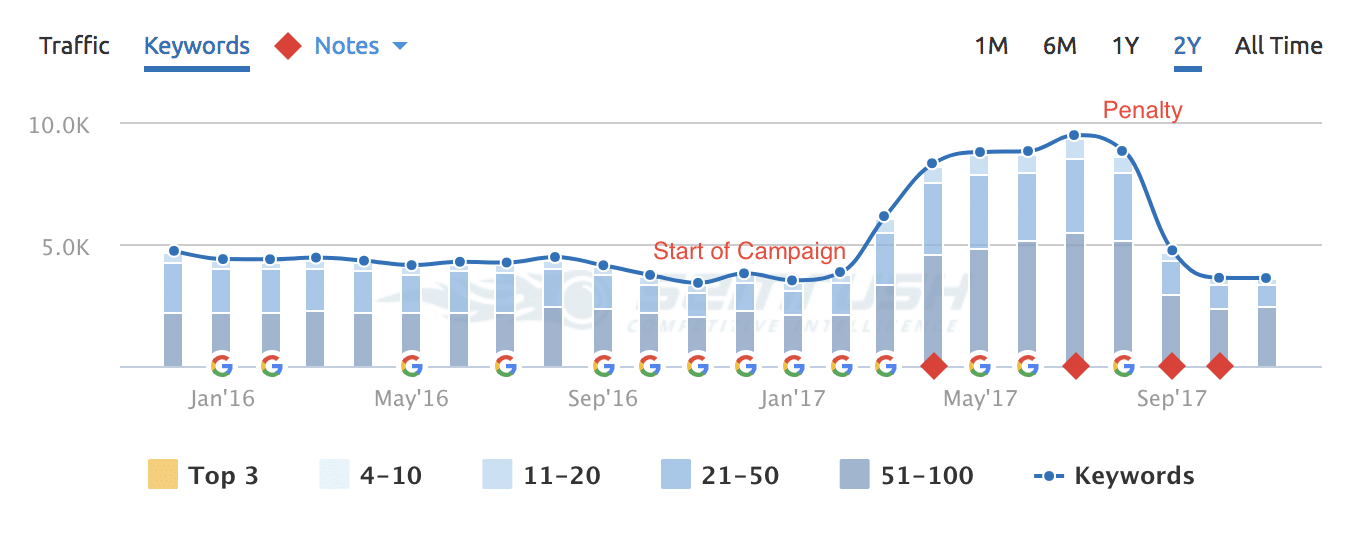
This is why good SEO agencies require what may seem like long-term contracts. We need the time to conduct keyword research, run audits, implement fixes, optimize the site, and make tweaks to continually improve performance.
I know it can be frustrating when you’re two months into a six-month campaign, and the results aren’t where you want them to be. However, good SEO takes time. Without contracts, agencies would feel pressured to resort to quick-and-dirty SEO tactics to make any money. You’d see results like the graph above.
Instead, good SEO agencies provide offer sustainable, healthy growth with contracts that help them stay accountable to their goals.
Why “Guaranteed Rankings” Is a Moving Target
Search results are personalized. Google adjusts what users see based on location, search history, and behavioral signals, which means an agency’s “#1 ranking” in a tracking tool may differ from what each potential customer actually encounters.
When a pay-for-performance contract is built around achieving “first-page placement,” there’s no single universal position being delivered. This matters for evaluating any guarantee you’re offered. Even an agency operating honestly can’t deliver a consistent position that every searcher experiences, because that universal position doesn’t exist. What gets delivered is movement within a measurement system, which is a different thing from visibility for the people you’re actually trying to reach.
Why AI-Era Search Raises the Stakes
AI Overviews, the synthesized summaries now appearing at the top of many Google searches. They draw from content that AI systems assess as credible, well-structured, and authoritative. The criteria for earning that visibility are in direct conflict with the shortcuts PFP agencies rely on.
Thin content built around low-competition keywords, pages loaded with repetitive phrases, and links from low-quality networks not only risk Google penalties, but are structurally invisible to AI retrieval systems. AI systems prioritize depth, consistency, and demonstrated authority. A site that earned its rankings through manipulated signals is unlikely to appear in AI Overviews or be referenced in AI-generated answers, regardless of where it ranks in traditional results.
The foundation that earns AI search visibility is the same one quality SEO requires: authoritative content, earned links, and a site that AI systems can parse and trust. A model built to hit contract metrics quickly and a model built to compound visibility over time are pointing in opposite directions.
Pay-per-Results SEO vs. Partnerships
A successful SEO campaign hinges on working with your agency like they’re your partner. When a relationship is centered around results-based SEO, there’s no active participation and little emotional investment between the two parties. It may even inspire an adversarial “me vs. you” or a company vs. agency relationship.
Ask yourself what trust looks like to you and whether the paid-per-results SEO model inspires trust within you. If it doesn’t, don’t pursue a relationship with an agency that fits that mold.
In a retainer model, accountability looks like monthly reporting that shows where rankings are moving and why, deliverables you can track (audits completed, content published, links acquired), and strategy explained in plain language. An agency doing quality work should be able to tell you what they did last month, what it was designed to accomplish, and what the data shows. That’s the kind of accountability worth asking for, not a payment trigger tied to a keyword crossing a threshold.
Traditional SEO vs. Pay-for-Performance SEO
The two models differ on more than payment timing.
| Traditional SEO (retainer) | Pay-for-performance SEO | |
| Payment model | Monthly retainer covers ongoing work regardless of ranking velocity | Payment triggered by hitting predetermined metrics |
| Transparency | Monthly reporting on work completed, strategy, and performance | Hard to audit methods used between payment checkpoints |
| Long-term traffic | Builds authority and content depth that compounds over time | Often targets low-competition terms that don’t drive meaningful traffic |
| Penalty risk | White-hat methods designed to withstand algorithm updates | Financial pressure incentivizes shortcuts that risk Google penalties |
| AI search visibility | Content built for depth and authority supports AEO alongside SEO | Thin or over-optimized content is unlikely to earn AI search visibility |
| Relationship quality | Consultant and partner with shared long-term goals | Transactional structure that can create adversarial dynamics |
What Should You Look For in an SEO Agency?
Looking to boost your search visibility on Google and other search engines? Want to drive more organic traffic to your high-value pages?
Before you start conversations with agencies, know what you’re evaluating. The questions below tend to surface more about how an agency actually works than any sales pitch will.
1. Total Transparency
Ask an agency:
- To walk you through exactly what they’ll do in month one and what you’ll see in their reporting.
- To explain their link-building approach in plain terms.
- What happens if a tactic doesn’t produce the expected result.
Specific, clear answers signal a healthy working relationship. Vague answers, jargon-heavy explanations, or confident reassurances without specifics are red flags in any pricing model.
It’s not normal to be confused about what your SEO company does for you. If you don’t see the value of their work or they constantly throw around buzzwords that ultimately don’t mean much, it’s time to reevaluate your partnership.
Have a campaign sync call with the agency and make sure everyone is on the same page regarding goals, methods, and understanding of the tactics. Also, look around their website to see if they offer educational resources to help you shore up your SEO knowledge.
The best SEO agency should be able to thoroughly and easily explain their processes to someone who doesn’t have SEO experience. If that’s a struggle, consider next steps with a different agency.
2. Realistic Goals
SEO agencies that guarantee first-page rankings for specific keywords or incredible traffic growth overnight are lying to you. As I mentioned before, SEO takes time. You won’t be able to rapidly achieve radical organic growth without putting in the work. Instead, aim for healthy growth over a few months.
Consistent growth built using data-driven SEO strategies is more sustainable and will be better able to weather Google algorithm updates. Pay-on-performance SEO simply doesn’t deliver in the long term.
3. Long-Term Outlook
Find an agency that focuses on both short-term and long-term goals. Short-term goals set the foundation for reaching those more complicated objectives that take more time. After all, if you’re just getting started with SEO, you can’t expect top rankings immediately.
When an agency focuses on the long-term, you know that they’re not in it for just a quick buck. They value your trust and the relationship between the two parties.
4. History of Successful Collaboration
Any agency you consider partnering with should be able to point to their successes and share them with you. Case studies are critical for highlighting an agency’s tactics and showcasing how they work with customers. Read SEO case studies to uncover how they approach problems and apply solutions.
When you review case studies, pay attention to how success is measured. Look for agencies that track more than keyword positions — organic traffic quality, conversion trends, and AI search visibility all tell a more complete story than rank movement alone.
Connect With a Partner
The best SEO agencies offer data-driven SEO strategies that are built on sound principles and previous results. At Victorious, we take an integrated approach to SEO and answer engine optimization (AEO), building content and authority that earns visibility in both traditional search results and AI-powered search features.
If you want to improve your search engine ranking, know that it will take time, but when done correctly, the results will pay off in dividends. free SEO consultation today.
Is pay-for-performance SEO legitimate?
It’s legal, but the model creates structural incentives that tend to work against your interests. Even well-intentioned agencies face pressure to use shortcuts when they’re earning nothing during the months that quality SEO requires. The result is often rankings that don’t last, and sometimes penalties that actively damage your search presence.
How much does pay-for-performance SEO cost?
Entry-level pay-on-results pricing typically starts around $650 to $950 per month, though cost varies considerably based on keyword competitiveness and the agency. What’s harder to see in that comparison is whether the targeted keywords have meaningful search volume, what methods are being used, and what remediation costs if a penalty needs to be addressed later.
What’s the difference between pay-per-click and pay-for-performance SEO?
Pay-per-click (PPC) advertising charges per click on a paid ad; it’s a paid media model with predictable results that stop when you stop paying. Pay-for-performance SEO is an organic search pricing model where payment is tied to achieving defined metrics, like rankings or traffic. PPC delivers immediate, paid visibility; SEO builds organic authority over time. They serve different purposes, and one doesn’t substitute for the other.
Do any reputable SEO agencies offer performance-based pricing?
Some agencies offer hybrid models with a performance component alongside a base retainer. A transparent bonus structure tied to traffic growth above a baseline is meaningfully different from a pure pay-on-results model, because it doesn’t eliminate the base incentive to do quality work. Pure PFP structures, where the agency earns nothing until metrics hit, are where the structural risk lies.